
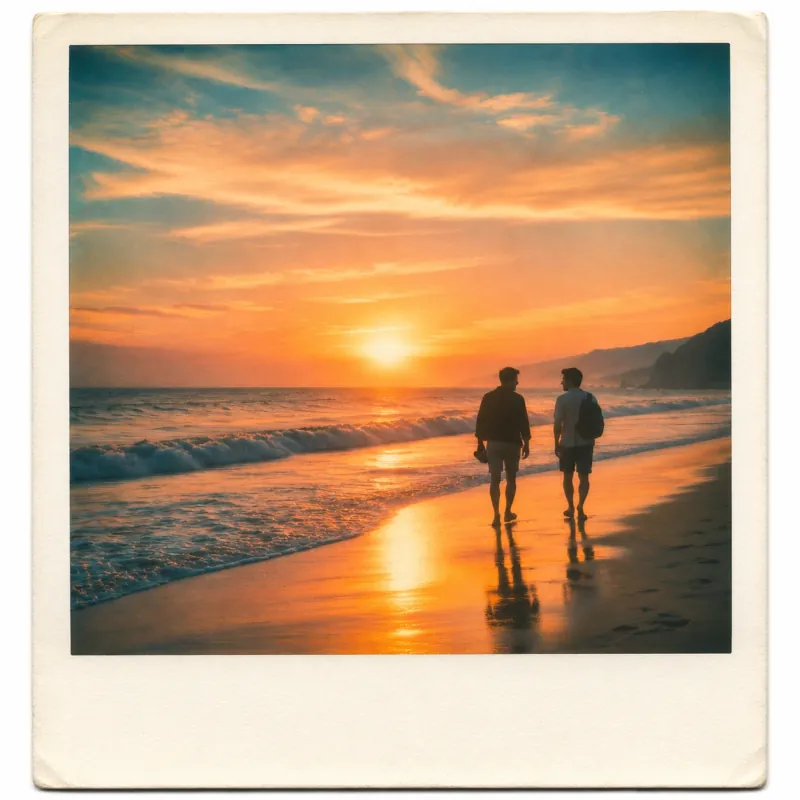
 nano-banana-2-1
Sun-Drenched 90s Polaroid Instant Film Snapshot
Authentic SX-70 instant film flash falloff, warm nostalgia, and crisp white Polaroid border.
Translate 8 world craft lineages, authentic material physics, and your attached substrate or sketch photos into master-grade prompts — freeing heritage techniques onto new substrates like black ebony, nephrite jade, framed panels, and modern industrial CMF.
1-Click Visual Craft Presets (Auto-fills specs & visual preview)
Keep authentic craft physics while freeing substrate & form (ebony, jade, framed art, jewelry, modern CMF)
Attach Reference Photo(s) (Optional · Dual-Image Vision)
Cascading World Craft Graph (Lineage → Medium → Technique)
Micro-Physics · Wire Gauge, Enamel & Metal Physics
Real Physical Scale (Prevents Unbuildable Micro-Details)
Calibrates detail density cleanly to small hand-held scaleBase Substrate Material (Decoupled Surface)
Beeswax-buffed jet-black ebony slab contrasting with gold & glazeExposed Substrate Balance
Edge-to-edge motifs & background brocade/cloud patternsArtwork Form & Mounting
Privacy & transparent pricing: reference photos compress in your browser for ephemeral DeepSeek vision with zero R2 retention, zero public feed & zero training. 3 free daily compiles, then 1 credit ($0.01)/run with 100% auto-refund on failure.
8 World Lineages
Cascading graph across Chinese, Japanese Kōgei, European, Persian, South Asian, LatAm, African & Bauhaus crafts
Multimodal Vision
Attach substrate photos, 2D linework drafts, or craft samples for native DeepSeek vision prompt synthesis
Decoupled Substrates
Break antique vase clichés by bonding heritage techniques onto ebony, jade, thangka boards, or modern hardware
100% Private
Reference photos are analyzed ephemerally in memory with zero R2 retention, zero public feed & zero training
Generic prompts like "Chinese porcelain style headphones" or "Japanese lacquer jewelry box" collapse into cheap souvenir textures because diffusion models lack specific optical and process instructions. Use this decoupled four-step workflow to achieve museum-authentic materiality and contemporary product innovation.
STEP 01
Decide first whether you are creating a finished contemporary design (putting traditional handcraft onto new forms and substrates), a flat 90-degree closed-contour tracing blueprint for real studio handwork, or a historically canonical museum piece.
STEP 02
Upload a photograph of your physical blank substrate (such as a dark ebony wood slab or jade plaque), a 2D line drawing, or an inspiring craft sample. Select one of the four reference roles so DeepSeek knows whether to lock the object geometry or extract the material DNA.
STEP 03
Pick from eight global craft traditions or type any technique into the search bar. Every selection injects concrete optical physics — such as cicada-wing celadon crackle, 0.1mm iridescent abalone shell, split mulberry silk sheen, or cold-cured gold filigree wire relief.
STEP 04
Pair your chosen craft with an intentional negative-space ratio so raw wood grain or jade translucency frames the handwork, compile with AI (3 free daily), and carry both your reference photo and compiled prompt straight into Image-to-Image or Multi-Model Studio.
Two structural blind spots ruin most AI decorative-arts renders: cultural noun hallucination and rigid historical vessel bias. Solving both turns AI from a novelty generator into a serious design prototyping studio.
First, many regional intangible-heritage names — such as Miao tin embroidery, Shiraz Khatamkari marquetry, Owari wireless shippō, or unfired cold-cured cloisonné painting — have sparse representation inside image model training weights. Typing the bare cultural name alone causes generators to invent generic floral wallpaper. Our cascading dictionary translates every craft into explicit optical physics: wire height, mineral crystal mesh size, warp-weft slub texture, glaze pooling, and subsurface scattering.
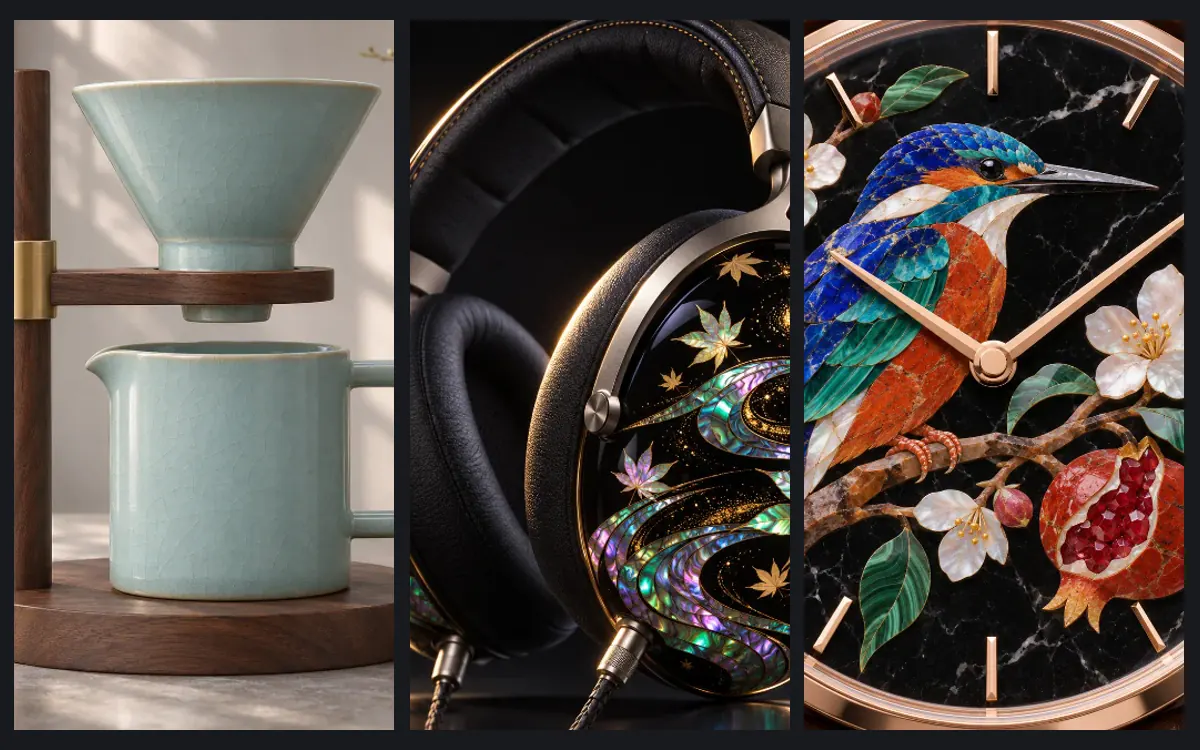
Second, real-world craft design is rarely about copying an antique pot. Master artisans and cultural product designers innovate by keeping the core handcraft process while liberating the base substrate and form factor — bonding gold filigree and mineral enamel onto solid black ebony or Hetian jade, applying Song Ru-kiln celadon glazes to minimalist pour-over coffee gear, or inlaying Wajima Raden shell onto flagship audio hardware.
Compare the everyday prompts below with the decoupled physical prompts compiled by this console. Click Load setup into builder on any card to customize the lineage, substrate, or motif immediately.
Weak Everyday Prompt
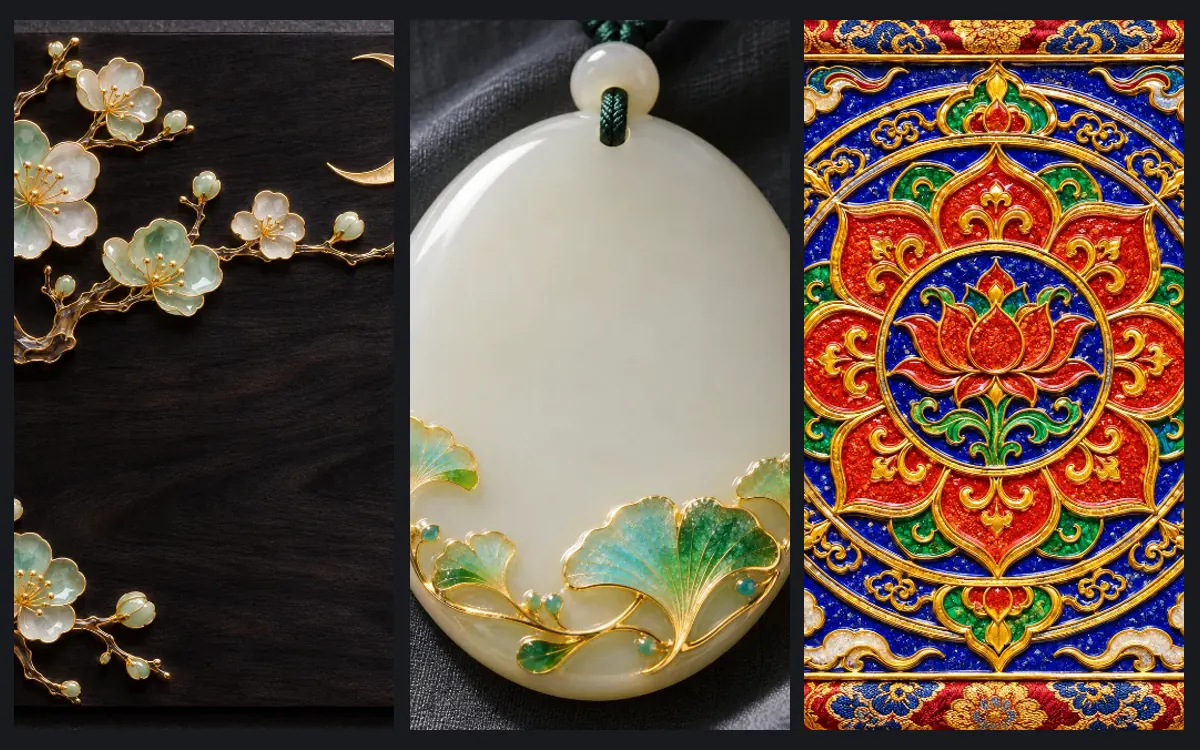
Chinese cloisonne crane and lotus artwork on black wood, traditional style, intricate gold lines, 8k
Triggers strong training bias toward a round antique bronze vase; flattens gold wire into 2D printed yellow lines and paints over the entire wood grain.
Structured Pro Prompt Output
Contemporary unfired cold-cured cloisonné filigree enamel wall panel crafted directly onto a flat slab of beeswax-buffed jet-black ebony hardwood: a serene white crane beside turquoise-and-lapis lotus blossoms. Upright hand-bent 3D golden brass filigree wire walls standing slightly proud above vibrant crushed mineral enamel frit pigments sealed under crystal-clear anti-oxidation cured glaze, leaving 40% exposed raw dark ebony wood grain as calm negative space, slim walnut frame, 45-degree raking 100mm macro studio light casting crisp micro-shadows along the wire ridges, strictly flat panel.
Explicitly decouples filigree enamel from copper vases, enforces upright 3D wire height + clear cold glaze, and preserves 40% bare ebony wood grain.
Weak Everyday Prompt
Minimalist coffee dripper made of Song dynasty Ru porcelain, sky blue glaze, crackle texture, studio photo
Produces glossy bathroom-tile cyan plastic without agate satin diffusion, sesame spur marks, or believable material joinery.
Structured Pro Prompt Output
Contemporary industrial-heritage pour-over coffee dripper and server set featuring clean Bauhaus cylindrical geometry crafted in Northern Song Ru-kiln sky-after-rain azure celadon ceramic: agate-rich unctuous satin glaze spiderwebbed with delicate cicada-wing ice crackle fissures (kaipian) and subtle toasted iron-clay foot rim, resting on a matte oiled black walnut stand with brushed brass collar. Soft diffused gallery daylight, 85mm medium-format lens, grounded contact shadow.
Specifies agate satin sheen (eliminating harsh plastic glare), cicada-wing crackle physics, exposed iron-clay foot, and walnut-brass joinery.
Weak Everyday Prompt
Black luxury headphones with Japanese mother of pearl shell inlay and gold lacquer wave pattern
Blends shell and gold into a muddy printed sticker rather than deep hand-burnished urushi lacquer with directional spectral shell refraction.
Structured Pro Prompt Output
Product macro photograph of flagship over-ear audiophile headphones whose sculptural oval earcups are finished in hand-burnished Wajima roiro mirror-black natural urushi lacquer inlaid with cosmic wave and maple motifs in 0.1mm micro-sliced iridescent abalone Raden shell flashing emerald-violet spectral highlights alongside raised Takamaki-e sprinkled 24k gold powder relief, paired with bead-blasted titanium yokes. 45-degree raking studio rim light on 100mm macro lens.
Pairs piano-deep roiro urushi reflection with 0.1mm abalone interference colors, raised gold powder relief, and modern bead-blasted titanium.
Explore tested artistic and craft recipes from our live library. Fill {{variable}} slots inline, save favorites to your private ⌘J vault, or click Remix in Builder to combine any motif with 8-lineage craft physics above.
nano-banana-2-1Authentic SX-70 instant film flash falloff, warm nostalgia, and crisp white Polaroid border.
 nano-banana-2-1
Curated Nano Banana visual generation & editing recipe.
 nano-banana-2-1
Curated Nano Banana visual generation & editing recipe.
 gpt-image-2-5
Community-verified GPT Image prompt for integrating word meaning into letters.
 nano-banana-2-1
Curated Nano Banana visual generation & editing recipe.
 nano-banana-2-1
Curated Nano Banana visual generation & editing recipe.
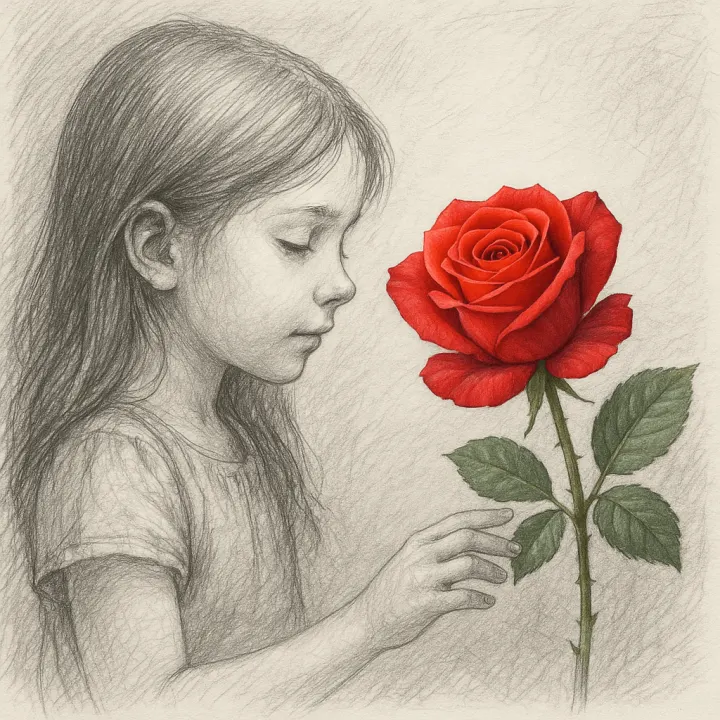 gpt-image-2-5
Community-verified GPT Image prompt for surreal interaction scene.
 gpt-image-2-5
Identity-preserving portrait edit applying classic trad goth makeup and hair while keeping pose.
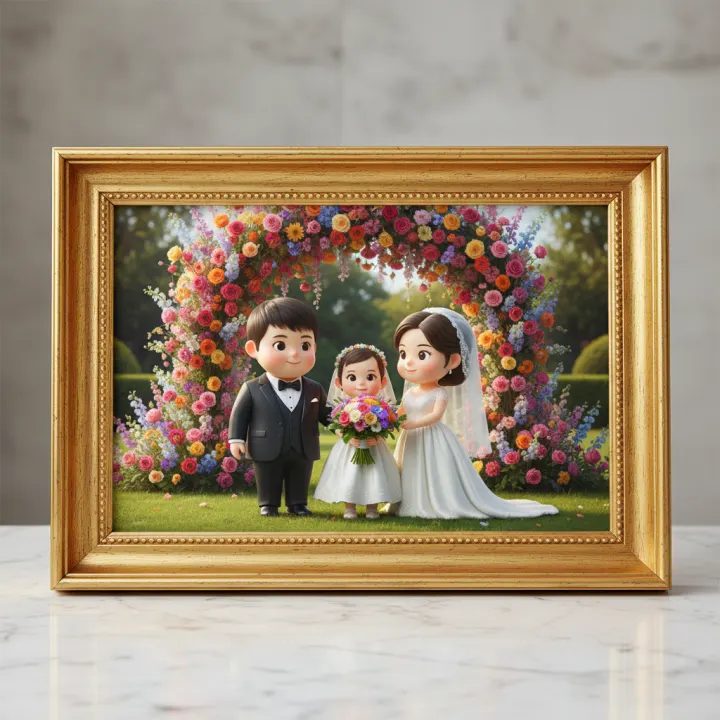 nano-banana-2-1
Curated Nano Banana visual generation & editing recipe.
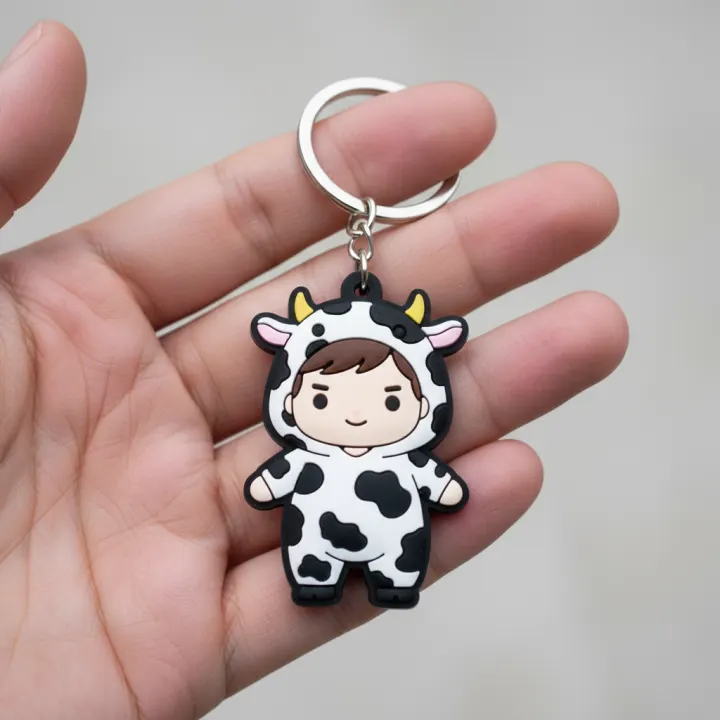 nano-banana-2-1
Curated Nano Banana visual generation & editing recipe.
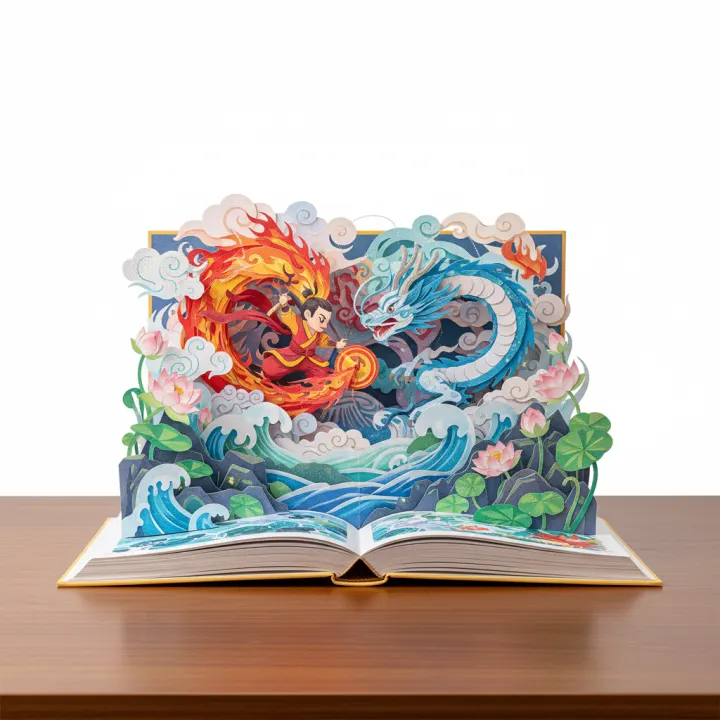 nano-banana-2-1
Curated Nano Banana visual generation & editing recipe.
 nano-banana-2-1
Curated Nano Banana visual generation & editing recipe.
Use this quick-reference matrix to pair traditional regional processes with high-converting modern substrates and lighting angles.
| Craft Lineage | Signature Techniques | Key Optical Physics Cue | Best New Substrates | Ideal Lighting |
|---|---|---|---|---|
| Chinese Heritage | Cold-cured cloisonné, Song celadon, Suxiu, Luodian, Dunhuang mineral | Upright 3D gold wire, ice crackle, split-silk sheen, crushed azurite grit | Black ebony, Hetian jade, framed panels, tea ware, luxury packaging | 45° side-raking macro softbox |
| Japanese Kōgei | Kintsugi, Wajima Maki-e & Raden, Bizen woodfire, Edo Kiriko, Mokuhanga | Roiro mirror urushi depth, 24k powder relief, abalone iridescence, ash glaze | Walnut/hinoki wood, stoneware, watch dials, minimalist electronics | Low-key grazing directional rim light |
| European Atelier | Murano millefiori, Florentine Pietra Dura, Limoges enamel, Aubusson tapestry | Internal glass canes & copper flecks, jigsaw stone veins, engine-turned guilloché | Dark marble, architectural lighting, boutique perfume bottles, horology | Transmitted backlight or polarized studio |
| Persian & Islamic | Isfahan Minakari, Khatamkari micro-marquetry, Iznik tile, Damascus koftgari | Sub-mm bone/brass star tessellations, watered steel waves, raised bole red | Archival boxes, architectural panels, brass hardware, leather bookbinding | Even diffused gallery overhead + rim |
| South Asian & Himalayan | Bidriware silver-on-black, Jaipur Meenakari, Zardozi bullion, Mineral Thangka | Matte jet-black oxidized alloy vs pure 999 silver, raised coiled gold purl | Planar thangka mounts, couture textiles, heirloom jewelry bezels | Warm angled studio key highlighting gold |
| LatAm, African & Bauhaus | Alebrije micro-dots, Huichol beadwork, Kente weave, Benin bronze, Slöjd CMF | Beeswax-pressed seed beads, warp-float geometry, bead-blasted anodized bevels | Sculptural art toys, acoustic panels, modern furniture & industrial CMF | Crisp natural daylight or studio softbox |
Different visual generators excel at different craft structures — from continuous metallic filigree cells to translucent jade and silk fibers. Every rate below uses CreoArt’s never-expiring pay-as-you-go wallet.
| AI Model | Strongest Craft Specialty | Substrate & Reference Adherence | Recommended Output Mode | Pay-As-You-Go Cost |
|---|---|---|---|---|
| GPT Image 2.5 | Cloisonné filigree cells, Pietra Dura inlays, Step-1 closed linework drafts & cross-material CMF | Highest precision for flat panels, exposed ebony/jade ratios & complex geometry | Contemporary Redesign & Step-1 Actionable Blueprint | 4–24 cr ($0.04–$0.24) |
| Nano Banana 2.1 | Song celadon glazes, Hetian jade subsurface glow, Liuli glass caustics & jewelry macro | Supports up to 14 reference images for substrate/mockup placement | Finished Artwork Macro Photography & Image-to-Image | 7 cr (~$0.07 / 1K) |
| Seedream 5.0 Pro | Dunhuang mineral rock-color, Gongbi silk, sacred thangka & Oriental tea-space framing | Superior Eastern color harmony and poetic negative-space balance | Framed Wall Art, Scroll Mounts & Interior Context | 10 cr (~$0.10 / 1K) |
| FLUX Fast Schnell | Zero-cost rapid motif exploration, symmetry checks & silhouette ideation | Fast text-to-image concepting before committing to high-res macro renders | Quick Draft Exploration | Free 3/day or 2 cr (~$0.02) |
Apply these five studio principles whenever adapting traditional crafts to contemporary design concepts or client custom mockups.
If you place filigree enamel or mother-of-pearl inlay onto prized black ebony or mutton-fat white jade and fill 100% of the surface with pigment, viewers can no longer tell what substrate lies underneath. Leaving intentional bare wood grain or translucent jade space creates unmistakable luxury contrast.
Flat front lighting erases the height of bent brass wires, couched Zardozi gold threads, and carved cinnabar lacquer coats, making handcraft look like flat wallpaper. A 45-degree raking softbox casts sub-millimeter edge shadows that immediately prove handmade thickness.
Terms like cloisonné, celadon, or Delftware strongly pull diffusion weights toward round vases and plates. When designing wall art, thangkas, watch dials, or box lids, lock both a flat panel substrate and an explicit anti-vase constraint.
Artisans tracing patterns for wire bending, fretwork, or embroidery need zero depth-of-field blur, zero specular glare, and strictly closed bendable contours. Switch Creation Output Mode to Actionable Craft Design Draft whenever generating working studio patterns.
Uploading a photo without stating its role confuses vision compilers. Tell DeepSeek whether your image is the physical blank substrate to decorate, a 2D sketch to materialize into 3D craft, or a finished sample whose texture DNA should transfer to a new subject.
Independent craft studios, jewelry houses, and cultural IP designers routinely test unreleased patterns, custom client plaques, and proprietary linework drafts. Unlike public community bots that broadcast every prompt and upload into searchable feeds, CreoArt is private by default.
Guest drafts and your ⌘J vault stay locally in your browser, while reference photos attached inside this console are compressed in your browser and read ephemerally during compilation — zero reference bytes are stored in public buckets or used to train models. Any downstream images you render in CreoArt Studio live in private storage with instant single-item deletion.
Clear answers on multimodal reference photos, decoupled substrates, specialist craft consoles, and studio handoff.
Your browser compresses the photo locally in memory and sends it directly to DeepSeek’s native multimodal vision compiler alongside your selected craft specs. Depending on the Reference Role you choose, it either reads your physical substrate’s shape and grain, converts your 2D linework sketch into 3D craft physics, extracts texture DNA from a sample photo, or reverse-engineers a full prompt from scratch.
Yes. Instead of dumping hundreds of tags on screen at once, the console uses a 4-level dynamic cascade (Cultural Lineage → Craft Medium → Specific Technique → Adaptive Micro-Physics) plus an instant search bar. You only see options relevant to your active craft, while representative crafts like Cloisonné Enamel Painting also offer a dedicated specialist studio.
Select Contemporary Craft Redesign at the top, pick your heritage technique, then choose Dense Black Ebony, Hetian Nephrite Jade, or a custom material under Base Substrate Material and set Exposed Raw Substrate Negative Space to 35–50%. The compiler strips away antique vase defaults and bonds the craft realistically onto your chosen surface.
Yes. Switch Creation Output Mode to Actionable Craft Design Draft. That instructs the compiler to output a 90-degree flat orthographic pattern sheet with clean closed contours, practical tool bend radii, and clear color-zone separation rather than an angled studio photo.
Use /prompts/art-craft when exploring 8 global craft lineages or blending cross-cultural techniques (such as Song celadon with Bauhaus wood/metal). Switch to /prompts/cloisonne-enamel when you want granular step-by-step control over wire gauge, mineral sand point-blue shading, anti-oxidation cold-cured glaze clarity, and planar thangka/ebony/jade mounting.
If you attached a substrate or sketch photo, click Carry Photo + Prompt to Image-to-Image to pass both your original file and compiled prompt straight into /image-to-image with zero re-upload. For pure text-to-image creations, click Render in AI Image Studio to open your chosen model pre-filled.
Every visitor gets 3 free AI prompt compilations per UTC day with no login or card required. Raw physical spec skeletons can be copied unlimited times for free. After your 3 free daily compiles, each AI compilation or refinement costs 1 credit (~$0.01) from never-expiring packs starting at $5.
Never. CreoArt operates zero public inspiration feeds for user uploads, never trains AI models on your files, and processes prompt reference photos strictly in ephemeral memory.
Dive deeper into our flagship Cloisonné Enamel Painting specialist console or render your compiled craft prompts across 24 private image and video models.
Flagship Specialist Console
Dedicated 5-step artisan prompt console covering Step-1 closed wire drafts, 24K flat filigree walls, mineral sand point-blue shading, anti-oxidation cold glaze, and ebony/jade/thangka framing.
Render your compiled craft prompts on GPT Image 2.5, Nano Banana 2.1, Seedream 5.0 Pro, or free daily FLUX.
Transform uploaded substrate plaques, product white-models, or 2D sketches into tactile finished crafts.
Stage finished cultural products, jewelry, and gift packaging on studio plinths with marketplace label locks.
Refine linework drafts, composite framing mats, or inspect high-res craft renders locally with WebGPU.
Switch to Video Prompt Director to animate subtle light sweeps across finished glazes, gold leaf, and silk.
One wallet from $5 with zero monthly subscription traps and 100% automatic refunds on failed runs.